VisualAPT is a version of APT (AUTOMATICALLY PROGRAMMED TOOLS)
GEOMETRY · LANGUAGE · MOTIONDefine geometry.
Express motion.
APT is Body-syntonic. Body-syntonic is a concept where a virtual object's position and pose are imagined as if it were a personified "ego" — or as the embodied programmer's/user's own body. Motion is described as one would move in that space. So, "Go Forward" and "Go Right" are used rather than say, Move +X, or Move -Y. It simplifies spatial programming tasks because the compiler/system keeps track of direction vectors, tangents and normals based on intent and world state.
- Body Syntony /ˈbɑːdi ˈsɪntəni/ noun
- How the physical body aligns, responds, and harmonizes with its movements or its environment.
01 THE APT LANGUAGE
MIT · 1956–1959APT: geometry
and motion.
Imagine yourself as the cutting tool. Follow the geometry. Let the computer work out the motion.
$$ Contouring: surfaces already defined
$$ PS: supporting part surface
$$ DS: curved lateral drive surface
$$ CS: terminating check surface
$$ Cutter engaged; forward direction set
CUTTER / 10
PSIS / PS
TLAXIS / 0, 0, 1
TLRGT
GOFWD / DS, TO, CSGOFWDGo forwardTANTOTangent toTO / ON / PASTRelationships to a boundaryPS · SupportThe cutter end remains on the part surface.
DS · GuideThe cutter flank follows the wall; the center path is offset by its radius.
CS · StopTO ends the move at first cutter contact with the check plane.
Original geometric illustration inspired by the supplied references. Scrub or play the path. This is a prescribed contour demonstration, not an APT interpreter or cutting simulation.
APT’s development.
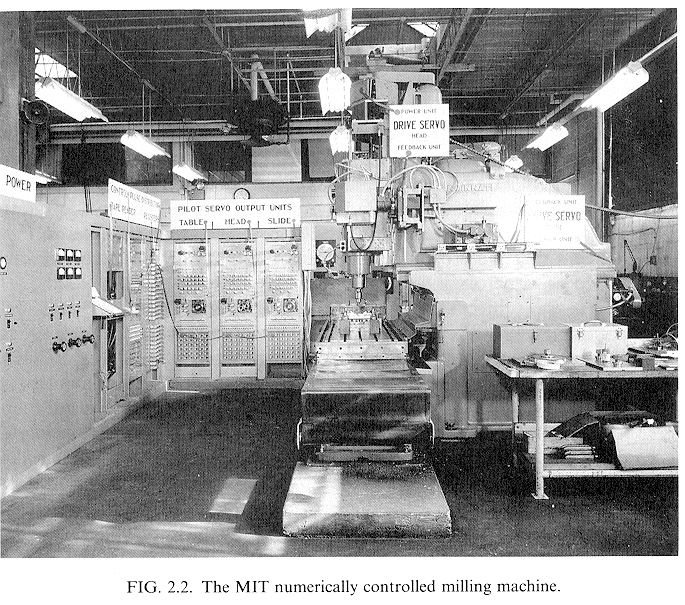
Douglas T. Ross led APT’s development at MIT with Air Force support and aircraft-industry collaboration. Automatically Programmed Tools turned descriptions of geometry and tool motion into paths for numerically controlled machines. NC hardware came first; APT made complex machining far more practical to program. [1]
Surface relationships.
APT can describe motion in relation to part, drive, and check surfaces. Its processor calculates cutter locations; a postprocessor translates them for a particular machine. The APT fragment describes three simultaneous relationships: the cutter end follows the part surface, its side follows the drive surface, and the check surface terminates the move. The illustrated part surface is planar; the curved drive surface determines the contour. The tool axis remains correctly oriented to the surfaces. That relational contouring language is the foundation for the BodySyntonic proposal.
MIT demonstrates numerical control.
Ross’s team develops APT with industry.
First APT language standard: ANSI X3.37.
RAPT brings geometric relationships to robot assembly.
A foundational language for NC and CAM. The first APT ANSI language standard was published in June 1974. [3]
APT’s legacy remains at the heart of many modern CAM workflows—even when the programmer works through a graphical interface rather than writing APT code. APT source and APT-like cutter-location data still connect toolpath generation to postprocessing: CATIA supports APT output, and Siemens NX can supply APT-like CLS data to ICAM. The interface has changed, but this intermediate description of tool motion remains a practical bridge to machine-specific NC code. [6]
START A CONVERSATION
Try VisualAPT.
Are you writing AI Robotics applications? We'd love to hear from you.
02 ROBOTICS RESEARCH
BODYSYNTONIC / RESEARCHA modern language
for robotics.
Keep the relational idea. Extend it to bodies that reach, touch, balance, and move through the world.
BodySyntonic explores a modernized representation of intention inspired by APT: pose, guide surfaces, contact, tangents, normals, timing, and force constraints. Its proposed Bodysyntonic Robot Language (BRL) would make those relationships explicit, connecting human-readable intent with robot motion and learned world models.
This is a research direction: a way to describe what should hold during movement, while the controller or planner determines how to achieve it.
Explore BodySyntonic ↗RELATED REPRESENTATIONS
Tool ↔ part ↔ surfaces
Body ↔ contact ↔ environment
From geometric relationships to physical intention.
03 CODE & COLLABORATION
GITHUBCode & examples.
A home for the VisualAPT repository, examples, and development notes.
GitHub04 ABOUT VISUALAPT
DEVELOPED BY TODD MUSCATAbout VisualAPT.
VisualAPT is Todd Muscat’s work with the APT language. This site brings the language’s history and geometric ideas into view.
Todd’s engineering work spans CAD/CAM, CNC motion, manufacturing software, simulation, AI and robotics (Physical AI).
Developer Todd Muscat ↗Sources, history & image credits+
- Douglas Ross’s 1970 N/C World interview · MIT archive. Also: MIT Science Reporter: Automatically Programmed Tools (1959).
- National Bureau of Standards: Standards for Computer Aided Manufacturing · APT entry records first publication in June 1974.
- Seymour Papert, Mindstorms (1980) · Body-syntonic learning, printed p. 63.
- University of Edinburgh: Freddy and RAPT · Geometric relationships in robot assembly.
- Historical machine photograph: MIT 2.810 machining lecture (2019), PDF p. 86, credited to Reintjes, Numerical Control (1991). Photograph date unspecified; no open reuse license stated.
- Valiant Turtle image: Valiant Technology Ltd., 1985, CC BY-SA 3.0. Original image reproduced without modification.
- Modern CAM: ICAM’s Siemens NX APT-like CLS interface; CATIA APT source and CAM-POST integration. APT-derived interchange is distinct from a full APT language processor.